Platform
Awareness—not authority.
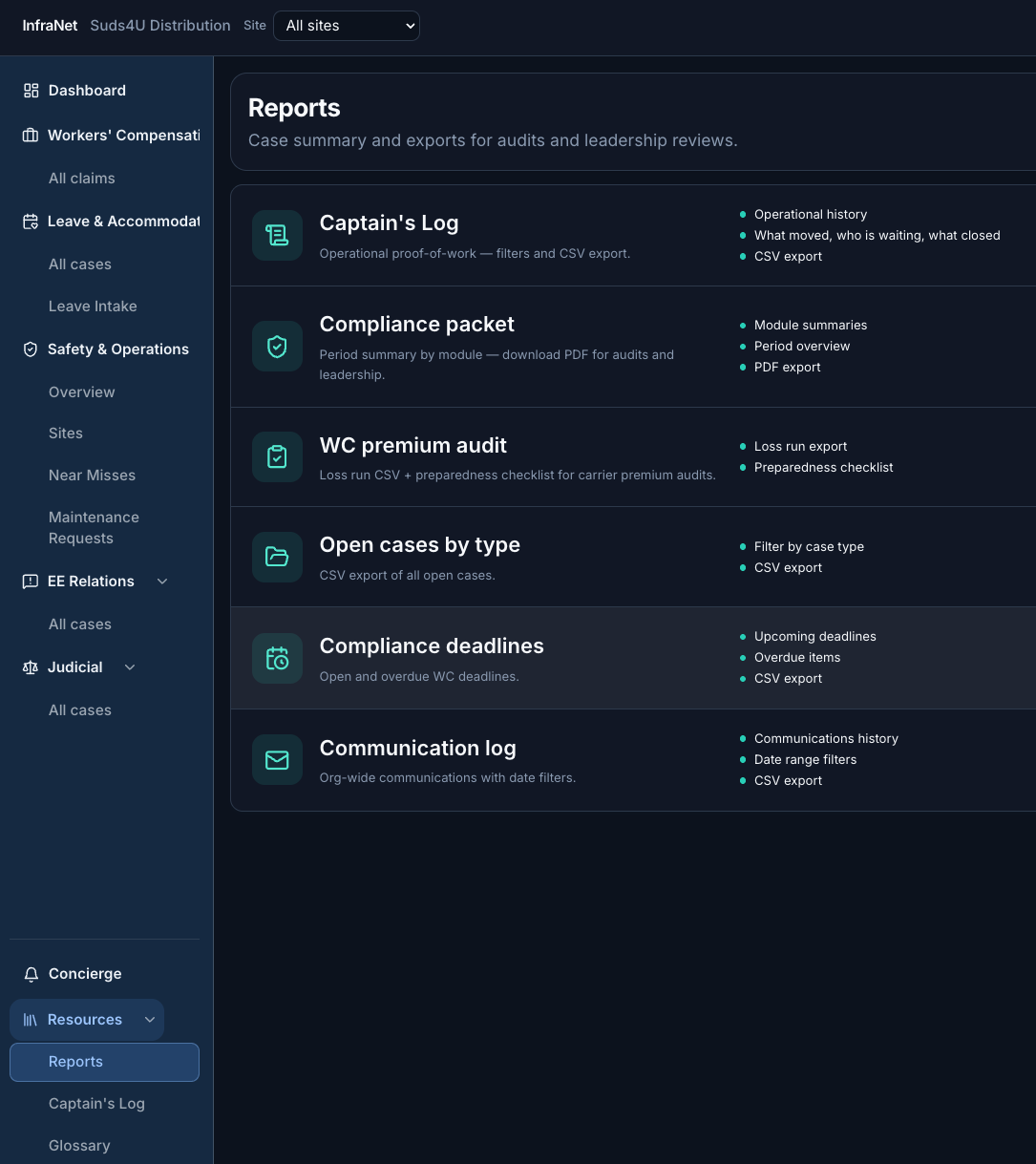
Captain is InfraNet’s operating intelligence: state-first attention over cases, deadlines, ownership, communications, configuration, and patterns. Captain’s Log preserves the operational record of what the platform saw and what people did.

Captain
Start with operational state—not an empty chat box.
Many “AI for HR” products begin by asking the user to type a question and supply the context the system does not have. InfraNet begins with the structured state already carried by the platform: open cases, deadlines, waiting-on intervals, intake queues, ownership, communications, risk signals, site structure, and configured responsibilities.
Captain is designed to work over that state. The experience should feel less like consulting a chatbot and more like the platform already understood which work appeared incomplete, stalled, inconsistent, or ready for a human decision.
The metaphor is deliberate. The organization is the ship. HR and leadership hold the helm. Compliance and operational risk are the icebergs. Captain reports what it sees. It does not steer.
State-First Attention
Captain sees the work InfraNet already carries.
Cases & Deadlines
What appears incomplete or late?
Captain can reason from supported case state, due dates, waiting periods, ownership, and missing operational steps without inventing a separate version of the file.
Communication & Intake
What needs a human review?
Supported intake and inbound paths can surface material that requires acceptance, clarification, or a decision before it becomes part of the official record.
Patterns & Configuration
What no longer looks consistent?
Captain can point toward repeated signals, configuration gaps, or drift for review while preserving the provenance behind the observation.
Where Captain Appears
Operational context at the moment someone needs it.
On Command Center attention
Supported Command Center rows can include a Captain nudge explaining what appears stalled or incomplete. The nudge adds operational context to the exception. HR still clicks into the source, reviews the facts, and decides what happens next.
During implementation and configuration
On supported implementation paths, Captain can infer from available roster and organization context, then ask HR to confirm or dismiss. The purpose is to reduce repetitive setup work—not silently rewrite the organization.
Around inbound communications
Where inbound routing is configured, Captain can help prepare a brief for human review before a proposed entry becomes part of the case record. The message can find the file without turning free text into an autonomous decision.
On a scheduled reconciliation cadence
Captain can support scheduled review of configuration and maintained reference state, flagging possible drift or gaps for operators to examine. Findings do not silently change production rules, deadlines, or legal obligations.
Captain’s Log
The operational memory behind the attention.
Captain’s Log is the register of operational activity around supported signals and work: what moved, what was flagged, which deadlines existed, what context accompanied the signal, and what people did next.
It is not a marketing blog or social feed. It is a searchable operating record tied to the underlying work when a reference is available and filtered by the permissions of the person viewing it.
When someone later asks when a pattern first appeared, what the platform flagged last month, or what context existed around a nudge, Captain’s Log provides a starting point that does not depend entirely on memory or a departed employee’s inbox.
Why They Work Together
Attention without memory is nagging. Memory without attention is an archive.
Captain and Captain’s Log are designed as a pair. Captain helps surface what needs a human now. The Log preserves the operational context around what was surfaced and how the work moved afterward.
That pairing also protects honesty. A nudge can be traced back to the supported state behind it. A pattern signal can retain its timing and reference. If work stalls without a signal, the organization can still examine ownership, process, and platform coverage rather than assuming the intelligence layer saw everything.
The broader employee event lifecycle gives Captain the connected operational context that isolated case tools and free-form prompts lack.
Authority Boundaries
Captain reports the iceberg. The helm remains human.
Captain does not make legal determinations, recommend termination or discipline, replace an investigation, certify compliance, autonomously change organization data, rewrite deadlines, scrape legislation into production rules, or watch communications outside InfraNet’s supported paths.
Confirming a Captain suggestion does not mean the organization is legally covered. It means a human reviewed an operational signal and chose how the work should continue.
This boundary is not a limitation hidden in fine print. It is the operating design. InfraNet facilitates attention and preserves context while HR, leadership, counsel, Safety, and other responsible people keep decision-making authority.
How Captain Speaks
Specific enough to help. Bounded enough to trust.
Detect
Name the operational condition.
The signal begins with supported case, deadline, communication, configuration, or pattern state—not a guess about intent.
Explain
Show why it deserves attention.
Captain can identify the incomplete step, elapsed window, conflicting context, or other bounded reason the item surfaced.
Yield
Leave the decision with people.
The user opens the work, reviews the record, and decides. Captain does not convert awareness into autonomous authority.
The Wider Platform
Intelligence is useful because the work underneath it is connected.
The InfraNet platform carries employee events across intake, ownership, deadlines, communications, attention, and closure. Captain adds bounded operational intelligence over that state. Captain’s Log helps preserve the corresponding record.
Concierge adds the human continuity around the platform: high-touch implementation and support, planned absence coverage, and quarterly and annual report presentations. Captain is supporting infrastructure inside that larger operating model—not the product’s personality replacing the people who do the work.
Common Questions
What to know about Captain and Captain’s Log.
Is Captain an HR chatbot?
No. Captain is a state-first operational intelligence layer over supported InfraNet cases, deadlines, ownership, communications, configuration, and signals. It is not a generic “Ask AI” box that depends on the user to recreate the platform’s context in a prompt.
Can Captain make employment or legal decisions?
No. Captain can surface operational attention and provide bounded context. HR, leadership, counsel, Safety, and other responsible stakeholders retain authority for legal determinations, discipline, investigations, safety judgments, and employment decisions.
Can Captain change organization data automatically?
No. On supported setup or reconciliation paths, Captain may infer or flag information for review. A human confirms, dismisses, or resolves the finding before organization data, rules, or deadlines change.
What does Captain’s Log record?
Captain’s Log preserves supported operational activity such as movement, flags, deadlines, signal context, and available references to underlying work. Visibility follows the permissions of the person viewing the Log.
Does Captain monitor every message the organization receives?
No. Captain works from information available within InfraNet’s supported product and routing paths. It does not watch personal inboxes or outside systems that have not been connected to the platform.
Bring us the work that keeps raising its hand.
Show us where attention is created, how people recognize what is stalled, and which operational history the organization needs to preserve.
Bring Us a Real Event