It is 6:05 AM on a Tuesday. In a logistics hub outside of Chicago, a shift supervisor stands at the head of a whiteboard, looking at three empty rows in the schedule. Three "no-calls."
The supervisor doesn't know that those three employees aren't "no-calls" in their own minds. They’ve each submitted a medical certification for intermittent FMLA or a new leave request via email to HR late Friday afternoon. But HR is in a different building, and that inbox won't be cleared until 9:00 AM.
The supervisor, feeling the pressure of a 15% labor deficit, marks them as "unexcused" and initiates a disciplinary write-up. Two weeks later, when HR finally processes the paperwork and backdates the leave, the supervisor has to retract the discipline. The employee feels retaliated against, the supervisor feels undermined, and the operation has already paid out thousands in unnecessary overtime to cover the "missing" capacity.
This isn't a failure of people. It’s a failure of coordination. This is the Capacity Trap.
The Operational Truth: Leave is Not a "Bucket of Hours"
Most organizations treat leave of absence tracking software like a digital filing cabinet. They focus on the compliance aspect: Does the employee have FMLA hours left? Is the doctor’s note valid?
But in a high-stakes environment like manufacturing or logistics, leave is an operational capacity event. When an employee goes on leave, work doesn't stop; it fragments. According to research, the total direct cost of employee absences, including wages, overtime, and replacement workers, averages 15.4% of payroll (SHRM, 2015).
The real problem isn't the leave itself; it's the "Wait-and-See" period. This is the 14-to-21-day window between an employee’s initial request and the final designation of their leave. During this time:
- Operations is guessing at daily capacity.
- HR is waiting for medical certifications.
- The Employee is guessing at their job security.
When leave is tracked in a vacuum, the operation stays blind.
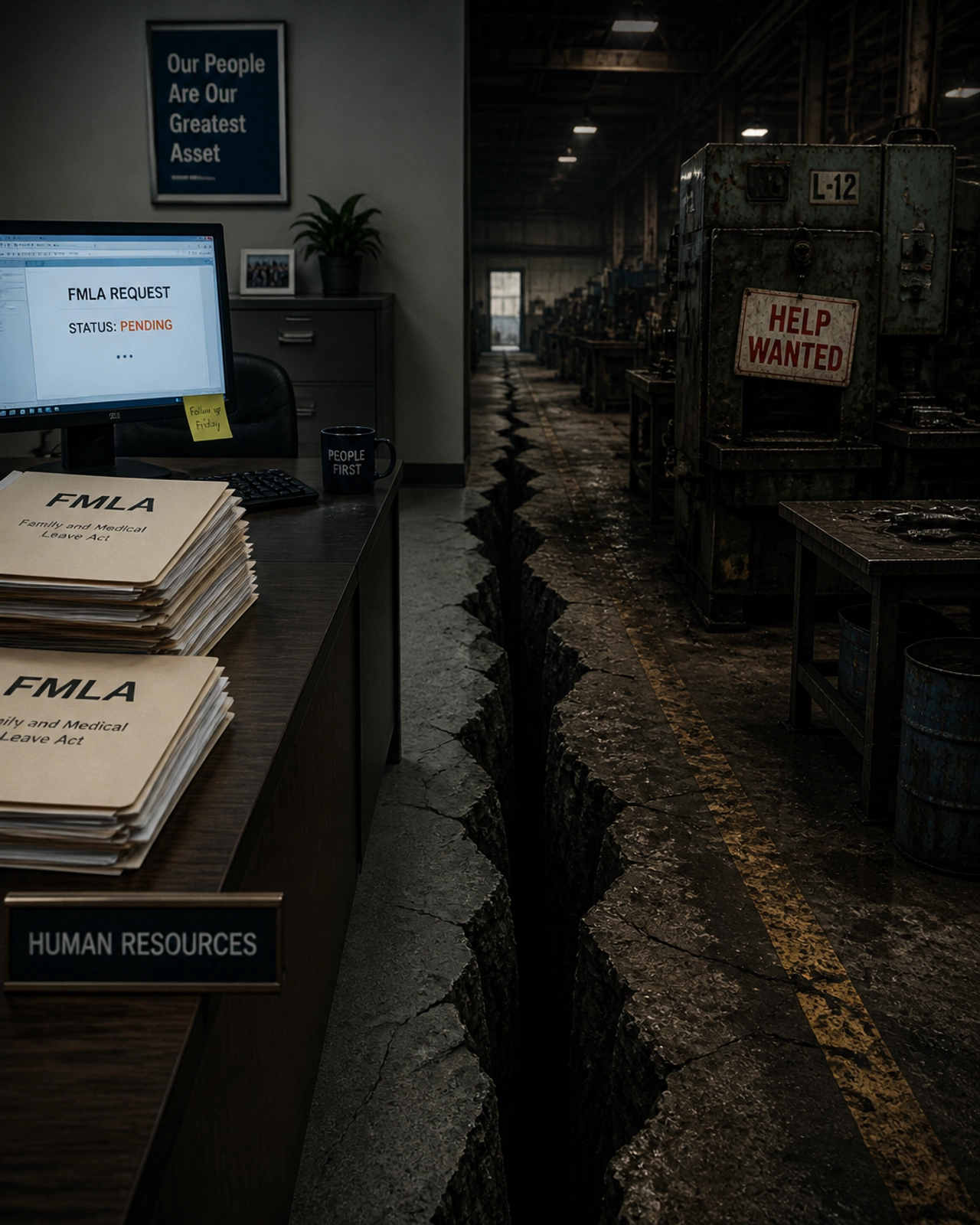
The Spreadsheet Trap: Why Traditional Methods Fail
For years, the "solution" to leave management was a complex web of spreadsheets, calendar invites, and BCC’d emails.
The traditional approach assumes that HR "owns" the leave and Operations "owns" the shift. This siloed thinking creates a massive handoff problem. When a worker in a food production plant needs an ADA accommodation or a sudden FMLA leave, the data moves through a series of disconnected gates:
- The Request: Stays in an inbox or a voice message.
- The Eligibility Check: Happens in a separate HRIS or a standalone leave of absence tracking software that the floor supervisor can't see.
- The Interactive Process: A slow back-and-forth between HR and the doctor.
- The Designation: Finally communicated back to the manager, often weeks after the absence began.
By then, the damage is done. Unplanned absences carry a productivity loss of roughly 36.6%, compared to 22.6% for planned ones (Investopedia/SHRM, 2024). Without real-time coordination, every leave event becomes an "unplanned" emergency for the person trying to run the shift.
The Cost of the Invisible Work
When an organization lacks integrated visibility, they rely on "Invisible Work" to stay afloat. This means supervisors spending hours every morning reshuffling teams, calling in off-duty staff, and authorizing emergency overtime.
Data shows that 47% of all overtime is used specifically to cover shifts for team members who are out (CRI, 2024). When you don't know who is coming back or when, you over-hire or over-schedule as a defense mechanism. This "buffer" is expensive and inefficient.
In 2024, the national absence rate hit 3.2%, meaning 3 in 100 workers are gone on any given day (U.S. Bureau of Labor Statistics). If your tracking software doesn't bridge the gap between HR’s compliance check and Ops’ capacity needs, you are essentially flying the plane without a fuel gauge.

A Better Approach: Leave as Labor Coordination
Modern operational intelligence doesn't just "track" leave; it coordinates it. A better approach treats leave as a multi-departmental workflow that requires immediate, shared visibility.
- Eliminate the Handoff: When an employee starts a request, the system should instantly flag the potential absence to the supervisor. No more "no-call" surprises.
- Parallel Processing: While HR handles the medical certification and legal eligibility, the operation can see the expected duration and "pending" status to adjust production targets or reassign tasks.
- Unified Timelines: The ADA interactive process shouldn't be a secret. If an accommodation is being discussed, the supervisor should be part of the feasibility conversation in real-time, not after the decision is made.
This is where InfraNet HR changes the game. We don't just provide another case management tool. We provide an integrated workforce management platform that connects the fragmented data between HR and Operations.
How InfraNet Closes the Gap
InfraNet transforms the leave event from a source of friction into a managed process. By connecting Workers' Compensation, OSHA Compliance, and Leave & Accommodation into a single operational view, we surface the hidden patterns that traditional software misses.
- Real-Time Status: Supervisors see the "pending" status immediately, preventing retaliatory discipline and attendance policy errors.
- Cross-Functional Visibility: If an injury on the floor turns into a Workers' Comp claim and then an FMLA leave, the data follows the worker, not the department.
- Predictive Capacity: By aggregating data across all leave types, InfraNet helps organizations see their true labor availability, reducing the reliance on emergency overtime.

The Broader Insight: Coordination is Compliance
The biggest risk in leave management isn't a missed deadline; it’s a breakdown in communication. Retaliation claims often stem from a supervisor who didn't know a request was pending. "Undue hardship" defenses in ADA cases often fail because the employer couldn't prove they looked at operational capacity properly.
The challenge isn't just "tracking" hours. The challenge is coordinating everything that happens because the event occurred. When you stop looking at leave as an HR record and start looking at it as a labor coordination problem, you stop reacting to absences and start managing your capacity.
Don't let your operation get caught in the Capacity Trap. Keep the work connected.
Frequently Asked Questions
1. What is the difference between leave tracking and labor coordination?
Leave tracking is the administrative task of counting hours and checking eligibility. Labor coordination is the operational task of communicating those absences in real-time so that shifts can be adjusted, overtime can be minimized, and production targets can be met without friction.
2. Why is the "Wait-and-See" period so dangerous for operations?
Because regulatory deadlines (like the 15-day window for FMLA medical certification) create a period where the employee is absent but the leave is not yet "official." Without shared visibility, supervisors often treat these as unexcused absences, leading to potential legal risks and morale issues.
3. How does integrated leave software reduce overtime costs?
By providing immediate visibility into pending leaves, supervisors can plan for absences days or weeks in advance rather than reacting at the start of a shift. This allows for better resource allocation and reduces the need for emergency, high-cost overtime.
4. Can leave tracking software help with ADA compliance?
Yes. A modern platform facilitates the "interactive process" by allowing HR and Operations to document accommodation discussions in a shared audit trail, ensuring that the organization can prove it acted in good faith to find a reasonable solution.
5. What is the most common reason for FMLA leave denials?
In 2024, the most common reason for initial denial was missing or incomplete medical certification (Sedgwick, 2024). Integrated systems help automate reminders to employees to close these gaps faster.
6. Does automation in leave management actually improve productivity?
Yes. Automation helps prevent project delays and "invisible work" by ensuring that every stakeholder: from payroll to the floor manager: is working from the same real-time data about who is available to work.
Recommended Reading
- The Handoff Problem: Why HR Data Silos Kill Operational Efficiency
- Beyond the 300 Log: Using OSHA Data for Safety Intelligence
- The Hidden Costs of Disconnected Workers' Comp Systems
Post Summary: Leave of absence is an operational capacity event, not just an HR record. This article explores how "The Capacity Trap" and the "Wait-and-See" period create friction between HR and operations, and how integrated coordination can reduce overtime and legal risk.
Meta Description: Stop treating leave like a bucket of hours. Learn how leave of absence tracking software coordinates labor capacity to reduce overtime & retaliation risks.
SEO Title: Leave of Absence Tracking Software: Solving the Capacity Trap